FRESH JOB GUIDES POSTED EVERY DAY
Best Countries That Offer Government Jobs to Foreigners in 2026
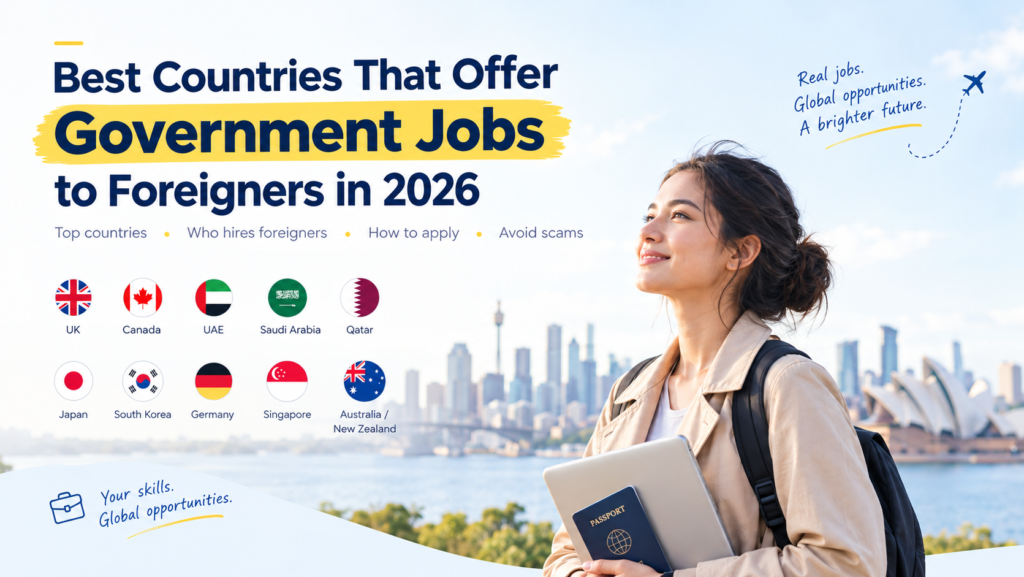
Very few countries let foreigners into core civil service roles such as ministries, tax offices, or immigration departments. Foreigners are hired in large numbers into publicly funded roles (government hospitals, public schools, state universities, research institutes) and government-run programs like Japan’s JET Programme and South Korea’s EPIK. The most realistic countries in 2026 are the UK, Canada, the Gulf states (UAE, Saudi Arabia, Qatar), Japan, South Korea, Germany, Singapore, and Australia/New Zealand, depending on your profession, nationality, and visa status. Some programs, like JET and EPIK, only accept citizens of specific countries, so check eligibility first.
Most people search “government jobs for foreigners” and expect a simple list of countries with open vacancies. The reality is more nuanced, and understanding it saves you months of wasted applications.
What “government job” really means abroad
Three categories get mixed up constantly:
- Core civil service. Ministries, federal agencies, tax and immigration offices. These usually require citizenship, and sometimes security clearance.
- Public-sector service roles. Government hospitals, public schools, state universities, and public research bodies. These often hire foreign professionals because of skill shortages.
- State-run programs. Government-operated schemes built specifically for foreign applicants, mostly teaching and cultural exchange.
Foreigners find real opportunities in categories 2 and 3.
Quick Comparison: Where Foreigners Get Hired
Comparison of countries hiring foreigners for government-linked jobs in 2026, including UK, Canada, Gulf states, Japan, South Korea, Germany, Singapore and Australia
- United Kingdom: NHS and some civil service roles. Best for healthcare, teaching, and tech. Needs a valid work visa or sponsorship.
- Canada: Provincial health authorities, universities, and research institutions. Best for skilled workers and PR holders. Needs a work permit or permanent residency.
- UAE / Saudi Arabia / Qatar: Public hospitals, schools, and universities. Best for nurses, doctors, teachers, and engineers. Needs qualifications plus a contract.
- Japan: JET Programme and local governments. Best for graduates. Needs a degree and an eligible nationality.
- South Korea: EPIK public school teaching. Best for graduates and teachers from eligible English-speaking countries. Needs a degree and a clean background check.
- Germany: Public universities, research institutes, and hospitals. Best for researchers, IT specialists, and engineers. Needs the right to work, and German language skills help a lot.
- Singapore: Public hospitals, universities, and research agencies. Best for healthcare, research, and tech. Needs a work pass.
- Australia / New Zealand: State health and education systems, and some agencies. Best for skilled migrants. Needs work rights or residency.
1. United Kingdom
The NHS is the UK’s biggest door for foreign professionals. Hospital trusts recruit doctors, nurses, pharmacists, and allied health staff from abroad, and many roles are posted on the official NHS Jobs portal.
Two cautions for 2026. Immigration rules, salary thresholds, and eligible occupation lists have changed repeatedly in recent years, and the route for new overseas care workers was closed in July 2025. Always check the current Home Office rules before applying.
For the Civil Service, each listing states who can apply. Most non-reserved posts are open to UK, Commonwealth, and Irish nationals, along with some EEA nationals who have settled status. Reserved posts, which are linked to national security, are for UK nationals only. Read the eligibility line before you spend an hour on the application.
2. Canada
Federal jobs on the GC Jobs portal give preference to Canadian citizens and permanent residents, and non-citizens make up only a small share of external hires. The easier path is usually the broader public sector: provincial health authorities, colleges, public universities, and research institutions.
Once you hold permanent residency or a suitable work permit, your options widen a lot. For many people, Express Entry or a provincial nomination comes first, and the public-sector job follows.
3. UAE, Saudi Arabia, and Qatar
Ministries mostly hire nationals, but government hospitals, public schools, and state universities regularly recruit expatriates on fixed-term contracts. Packages often include tax advantages, housing, or allowances, though this varies by employer.
Two things to know. Contracts are usually temporary rather than permanent civil service posts, and several Gulf countries are actively prioritizing citizen employment, so competition for some roles is tightening. Nationalization rules, such as Saudization and Emiratization, have tightened further in 2026, so expect more competition for roles that nationals can fill.
Scam warning: never pay anyone to “guarantee” a Gulf government job. This is one of the most common job scams, especially on Facebook and WhatsApp groups. Real employers do not charge for offers.
4. Japan (JET Programme)
The Japanese government runs the JET Programme, which places foreign graduates as assistant language teachers or international relations coordinators in schools and local governments.
Applications run through the official JET channels and Japanese embassies or consulates, and only citizens of participating countries are eligible. Check the current eligibility list before you invest time in an application. The 2027 JET application cycle is open now, and deadlines vary by country. Check your nearest Japanese embassy or consulate for the exact date.
5. South Korea (EPIK)
EPIK places foreign English teachers in public schools. Eligibility is limited to citizens of a short list of countries (the US, Canada, the UK, Ireland, Australia, New Zealand, and South Africa), so check that your passport qualifies before anything else.
You also need a bachelor’s degree and, unless you have an education degree or teaching license, a TEFL, TESOL, or CELTA certificate of at least 100 hours. Intakes run twice a year, so plan your documents well ahead.
6. Germany
German public employment splits into two groups: Beamte (career civil servants, usually EU citizens) and Angestellte (public employees on standard contracts).
Non-EU professionals most often enter through public universities, research institutes, hospitals, and municipal bodies as Angestellte. Programs like the EU Blue Card and the Opportunity Card (Chancenkarte) exist to attract skilled workers, but conditions apply. The Blue Card needs a job offer, while the Opportunity Card is for job seekers without one. German language ability is a major advantage even where English is accepted at work.
7. Singapore
Singapore’s public hospitals, universities, and research agencies hire foreign talent, particularly in healthcare, science, and technology.
Foreigners typically need an Employment Pass or a similar work pass. The Employment Pass has a minimum salary that rises with age, and applicants must also pass a points-based assessment called COMPASS. The criteria are updated periodically, so check the official Ministry of Manpower site before applying.
8. Australia and New Zealand
The Australian Public Service requires citizenship by default, but an agency head can waive it. Non-citizens need valid work rights, and temporary visa holders can usually only be hired on non-ongoing contracts that match their visa. State health and education systems are more flexible for people who already have work rights.
New Zealand’s public sector also has its own eligibility rules, so check the official New Zealand government jobs and Immigration New Zealand pages before applying. For both countries, most foreigners enter through skilled migration visas first.
How to Apply: Step by Step
- Choose a profession first, then a country. Nurses, doctors, teachers, engineers, and researchers get sponsored far more often than general graduates.
- Use official portals only. Government job sites, hospital careers pages, and university pages beat blogs and social media posts.
- Read the eligibility line before the job description. Phrases like “citizens only” or “must have the right to work” decide whether you should apply.
- Check the visa route. A job offer without a viable visa path is a dead end. Use the official immigration website.
- Prepare documents early. Degree verification, experience letters, language test results (IELTS, TOEFL, or the local language test), and police clearance can each take weeks.
- Tailor your CV to local norms. CV formats differ between the UK, Germany, and the Gulf.
- Track deadlines. Programs like JET and EPIK recruit seasonally, and missing a window can mean waiting a full year.
Common Mistakes to Avoid
- Paying for a guaranteed job. Genuine employers do not charge fees for offers. Report anyone who does.
- Believing “visa guaranteed” promises. Only the immigration authority decides visas, not recruiters or agencies.
- Ignoring nationality rules. Programs like JET and EPIK only accept citizens of specific countries. Check your passport before you start an application.
- Ignoring language requirements. Even where they’re not mandatory, basic local language skills improve your odds, especially in Germany, Japan, and Korea.
- Using one CV everywhere. A CV that works in the UK can look wrong in Germany or the Gulf.
- Chasing the “perfect” country. The best country is the one where your profession is in demand and your documents already qualify you.
- Relying on outdated blog posts. Rules change. Confirm everything on official sources, including this article.
Frequently Asked Questions
Can foreigners work in government jobs?
Sometimes. Core civil service roles usually require citizenship, but foreigners are widely hired in public hospitals, schools, universities, and state-run programs.
Which country is easiest for foreigners to get a government-linked job?
It depends on your profession and nationality. For healthcare workers, the UK and Gulf countries are common starting points. For graduates, Japan’s JET Programme and South Korea’s EPIK are structured options, but both only accept citizens of eligible countries, so check your passport first.
Do government jobs abroad offer visa sponsorship?
Many public-sector employers in healthcare, education, and research do, but it varies by role, employer, and current immigration rules.
Are government jobs for foreigners permanent?
Often not. Many are fixed-term contracts, though some can lead to residency or longer-term employment.
How can I avoid job scams?
Apply only through official government, hospital, or university sites, never pay for an offer, and verify the employer independently.
Final Thoughts
The best country for you isn’t the one with the flashiest ranking. It’s the one where your profession is in demand, your nationality is eligible, and your qualifications already fit the visa rules.
Pick your field, verify on official sources, and move one step at a time. If someone rushes you or asks for money before an offer, walk away.
Rules and eligibility change, so always check official sources before applying.